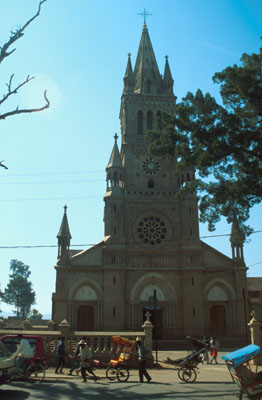
Christian church in Antsirabe.
13. History
Madagascar has old and rich history. All of the three human races (equatorial, Eurasian and Asiaamerican that means black, white and yellow) took a part on forming of anthropological types of today Madagascan population. Unlike the African continent is population of Madagascar anthropologically and by language tied to southeastern Asia. There are several theories about settling of Madagascar, we can not consider any of them as definite.
|
Generally it is concluded that the oldest known inhabitants of Madagascar were by their anthropological type, way of life and perhaps by language very similar to Paleolithic ancestors of today’s San people (Khoisan). Probably between 10th and 6th century BC, the protomalayan population belonging to Melanesian austro-african type so called Vazimbs who merged with indigenous inhabitants in the way that the characteristics of Negroid race prevailed, moved to island from Sumatra. It is assumed that in 2nd century BC the second migration wave of population from Southeast Asia, south Sumatra, reached its peak From 1. century AD migrated population from Java and the last immigrants from southeast Asia came to Madagascar in 16th and 17th century. That would explain why Sumatra and Madagascar in the oldest Arabian book of travels are called the same - Wákwák.
From 7th century AD, Arabs were spreading to Madagascar. They controlled mainly west coast, where they founded many city-states, similar type like those in eastern Africa. The excavations that revealed the ruins of cities build in style of south Arabia are persuading evidence. From 3rd century AD Bantu from east Africa, mainly slaves, were coming to island.
The oldest sporadic information about Madagascar is from Arab geographers and annalists, who called the island Moon Island- Džazírat al Kumur or Wákwák. First state formations were created in the period before 14th century AD on the west and southeast coast of island. The state of Sakalavas conquered thanks to policy of its rulers several territories. It reached it’s golden age in years 1600 to 1680 during the rule of Maroseránana dynasty. However, they later disintegrated on independent dukedoms, their power was in even in 18th century menace for Imerian states in inland and some of them were submitted.
The state Betsimisaraka was created on the east coast in the first half of 18th century. The smaller state formations were created in the south by tribes of Betsileo and Muslim Antaimorons that played significant role in infiltrating of Islamic culture to Madagascar.
Effort to unite the country has origin in area of central Madagascar, where Merinas established strong feudal type of state. During the rule of Ralamba (1575-1610) the power of imerin ruler spreaded to whole ethnical territory of Mrinas. He named the country he ruled Imerina ambaniadro (ruling everything under the sun). During the rule of his successors continued the expansion mainly to north, parallel with this the political center and residence of the ruler moved to Antananarivo. The class differentiation of Merina society was increasing, the feudal relationships were formed, but simultaneously 100 years long age of feudal disintegration began. Imerina broke to 4 independent dukedoms, which were unceasingly fighting among each other. Finally, at the end of 18th century ruler Andrianampoinimerin (1787-1810) united these dukedoms and annexed several neighboring territories to Imerina. However, he did not achieve greater successes against Sakalavas. States Boina and Menabé became his vassals. In the year 1794 he captured city Antananarivo and he moved there his residence.
The country was newly divided into 6 administrative provinces. Social-economic relationships were fixed in royal laws (kalabres). The social and economic stratification of inhabitants was complicated. The basic economic administrative unit became village common fokonolona. The agricultural production and crafts were developing, craft guilds were created, market was on it’s top. Market with foreign countries achieved the value of 200 000 piastres that is about 1 million golden francs.
Imerina became in touch with Europeans relatively late in comparison with Sakalavian states. Portuguese discovered the island in the year 1500 during the journey to India and they named it Island of Saint Vavrinec. In 17th century Madagascan coast became important basement of European pirates, who were attracted by rich market in Indian Ocean. They established small pirate republics there and they built up forts. They keep some places until 19th century. They sold shooting weapons to natives and taught them how to use it.
First efforts to colonize the country came from France. In the year 1642 cardinal Richelieu asked for concession for monopole market with Madagascar, which obtained newly founded company called Compagnie de l’Orient. French built the fort called Fort Dauphin on the east coast that became a residence of governor. However, they had to leave the island already in the year 1674, because of resistance of inhabitants. Since this happened France laid priority claims to the island.
The second attempt to occupy the island was in the half of the 48th century. In the year 1750 France bought the island Ile de Saint Maire on the east coast from ruler of Betsimisaraka kingdom and made several agreements with sakalavian chiefs.
Noble Móric Beňovský in the service of French government came to island in the year 1772. He was born in Vrbové near Piešťany and became a governor for a short time. He followed more his own aims than interests of France, so the French government took him away all his functions. He came back to Madagascar in the year 1785, he proclaimed himself Caesar of Madagascan empire and he started to make his plans for overruling the island from Antongil gulf. Together with Netherlander merchants, he was the part of market with slaves and he got financial support for his plans from Boston circles. French government wanted the island back according to law and sent against him army troops from Mauritius Island in the year 1786. Beňovský was defeated in battle.
Two factors played the role in the history of Madagascar in the 19th century. It was an effort on unification of the whole Madagascar, in center of which was Imerina kingdom. The second factor was penetration of European colonialism pretending that they want to fight against market with slaves and spreading of European civilization. Christian missions started to work on island and European merchants widen their activities. Characteristic feature of fight about control of Madagascar was rivalry between England and France that last until the end of 19th century and culminated by French occupation and colonization of Madagascar. During the short inner development (incomplete 100 years) of Madagascar, we can register rapid growth of productive forces. Imerina changed from early feudal state on strong centralized feudal state, in which new capitalistic relations appeared and began a formation of politically, economically and culturally independent nation of Malagasy. Imerina ruler Radama I. (1810-1828) continued in policy of his father Andrinampoinimerin and he tried to enlarge the territory of Imerina on whole island. To achieve this he needed strong, modernly equipped army, so he was working on trade contacts with Europe. He was the first ruler who accepted the title “king of Madagascar” and he named the empire Malagasy state. At the same time, a name “Malagasy” was firstly presented and used for whole population of island, irrespective of ethnical origin. In this age despite of ethnical, political, and class differences appeared first indications of national consciousness and was created unite Malagasy nationality. To its creation contributed migrations of population and common fight against European penetration and colonization. During the rule of Radama I. and his successor Ranavalona I. (1828-1861) lot of important changes appeared in economic structure and social-economic relationships in Malagasy society. Mainly during the rule of Radama I. European technology and literacy spread on the island together with the market contacts with Europe. The new differentiation appeared in Malagasy society and new capitalistic manufacturing relations were set up.
In the year 1828, Englishman Cameron set up first printer in Antananarivo. The schools were established, in the year 1828 there was already 28 schools. After the 15 years from their establishment 15 000 students learned to write and read. Antagonism between old feudal nobility and new aristocracy and national bourgeoisie together with rising class differences of Malagasy society reached its top in years 1863-1864 during the unrests, uprising and military overthrow, that signified the beginning of new economic and cultural development of Madagascar. The significant role in this process has Rainilahiarivony - prime minister and official lover of three queens, who ruled in the last period of independence of Madagascar: Rosaheriny (1863-1868), Ranavalony II. (1868-1883) and Ranavalony III. (1883-1897). His aim was to unite and modernize Madagascar and create a modern state able to repulse every military attack from outside. In the year 1875 government installed free medical care and year later, in 1876, 6 years earlier than France, issued a law about free and compulsory school education for kids from 8 to 16 years. It was founded more than 2000 schools, which were visited by more than 116 000 students in the year 1882, so many like during the French colonial administration in 50s of 20th century. Near the hospitals, which were founded by Englishmen in 1863 and about 2 years later by Norwegians, were created medical establishments. First Malagasy doctors were educated here. Tens of best students studied in the European universities. Future specialists in various branches of industry and agriculture studied in industrial school in Antananarivo. A newborn Malagasy intelligence started to issue first books and newspapers. Interest in history rapidly rose, royal laws (kabars) have been issued. Rainandriamanpandry wrote his first historical work Tantara sy fombandrazana (History and tradition of ancestors). This promising development was cut by French occupation.
In the year 1883 French government applied its right on protectorate over northeast coast of island according to treaties signed with local chiefs before unification, right for free trade and exteriorizations for all French citizens. Malagasy diplomatic mission refused ultimatum, left Paris and French government began military actions against Madagascar. In the years 1883-1884 French government barbarously destroyed several strategic ports. A year later Rainilahiarivony’s government proposed to French government discussion about armistice and accepted the treaty, which limitated sovereignty of Madagascar. In the year 1890 France recognized British protectorate over Zanzibar and secured for country a free hand over Madagascar. In the year 1895 the French expeditionary corpse that had 15 000 men, lead by general Duchesne, began a march on Antananarivo. Government in the fear from rising people’s movement that was demanding for social reforms and other concessions in democratization of public life did not proclaimed general mobilization. Malagasy professional army that had 24 000 men, equipped by modern weapons, retreated nearly without fight, however people were prepared for protection of capital. The government capitulated 30.9.1895, French army entered Antananarivo without fight and 1.10.1895 was signed the new treaty about protectorate, which retained queen Ranavalona III. on the throne, but France had right to manage interior and external matters of island. 6.8.1869 Madagascar became a directly administrated French colony. Queen Ranavalona III. and Rainilahiarivony were deported on Réunion.
Malagasy people did not give up without fight. In the year 1896 the movement of resistance outgrew to national liberation war. France sent more reinforcements and general Galiény (well known for his “pacifiable” activities in west Africa and Vietnam) to fight against guerillas led by their secret commander Rainandrianampandry. Despite of reprisals and terror of colonial regime, Malagasy people fought until total exhaustion of fighting forces. The fight against French occupation cost 700 000 human lives. Until 1904 Galieny was successful in pacification of Malagasy, but individual uprisings and unrests in different parts of island lasted with pauses until 1915.
Malagasy administration apparatus was destroyed by installment of French administration at head of which was general governor. A systematic fight was led against Malagasy culture and national consciousness, Malagasy language, history and geography were prohibited. Land was proclaimed as ownership of French state in 1896 and large companies gained concessions for using of large agricultural and forest areas and minerals. The growing of fruits good for export was installed. This growing was harmful for population because they could not grow vegetables used for feeding of inhabitants, like rice. Madagascar was self-sufficient in growing of rice in 19th century, but during the colonial era, it had to import it.
Political consciousness and national liberty movement in Madagascar started to grow again after the First World War and stagnation that lasted several years. Worker class began to develop, unions, strike movement were created, Malagasy intelligence entered in the relations with progressive French public. In the years 1936-1939 Malagasy national liberation movement organized itself into National front. New progressive newspaper written in Malagasy language started to be issued. These newspaper demanded complete independence of Madagascar. Colonial regime used all methods for suppressing the movement.
The Second World War brought new wave of terror and reprisals against progressive forces on the island. In the year 1943 was finally reached partial détente and activity of Malagasy unions was restored. First elections were in the year 1945. Malagasy national liberation movement, centered in Party for restoration of independence of Malagasy nation (PRINM) won 54 % of votes and it’s candidates Raseta and Ravoahangy became deputies in French parliament. In 1946 was created well organized political party from national liberation movement, with solid program of creation of independent Madagascar. This party was called Democratic movement of Malagasy revival (MDRM) in the head of which was dr. Raset. Deputies applied for annul of treaty signed in the year 1896 and creation of independent Madagascar under the French union. MDRM gained big popularity, number of members rapidly increased, it founded schools, co-operatives, issued Malagasy newspapers and magazines.
In the year 1947 first Madagascan elections and national party congress of MDRM should take place. French colonial regime that was afraid of strengthening national liberty movement started doing terrorist actions and mass reprisals. Malagasy deputies were relieved of immunity, judged by a court and 17 leaders of party (Raset and Ravoahangy were among them) were sentenced to death. General armed uprising started on the island. About one million people took part in it. Despite military and technical superiority of the colonists, it lasted for two years until it was suppressed. According to official estimations up to 100 000 Malagasy were killed, 20 000 were sent to jail and concentration camps. French troops were using similar terrorist methods as they used later in Algeria and Vietnam. State of emergency proclaimed in April 1947 lasted until the end of year 1956 and Malagasy leaders were allowed to come back from exile in France only after gaining independence in 1960.
Political parties could be formed only after proclamation of so-called Framework Law for French colonies. Up to 20 political parties were formed immediately. Colonial government supported moderate Social-democratic party of Madagascar (PSD) whose leader was former teacher Philipobert Tsiranan. Progressive forces united to Party of Congress for independent Madagascar (AKFM) demanded independence, Madagascan leave from French union and socialistic economy.
The year 1958 represented a new stage in national liberty fight in all French colonies. De Gaulle came with a new conception of French union that should replace compromised French union and Framework Law. In September 1958, a referendum on new constitution took place. Despite the fact that AKFM challenged the people of Madagascar to vote for “no”, the majority of participants of the referendum voted for French union and Madagascar gained autonomy as the first member state of Union. In 1959, National congress voted for amnesty for patriots sentenced after the uprising in 1947. Political life started to develop more liberally and finally 26.7. 1960 a independence of Malagasy republic was proclaimed. Malagasy republic soon became the member of UN. However, France was keeping its strategic and economic positions on the island. Diego Suaréz stayed the basement of navy. Politician orientated on the France Philibert Tsiranana became a president. Malagasy republic became one of the pillars of Afro-Malagasy union.
Pro-French and pro-western orientated government of president Tsirinana and PSD kept the power until May of 1972. Military rule in the head of which was general Ramanatsoa took the power in 1972, after the vast unrests. Ramanatsoa changed the foreign policy of Madagascar and established diplomatic contacts with Arabic and socialistic countries and strengthened alliance with progressive African regimes. He made steps to achieve the better economic situation and limitation of control of Madagascan economics by foreign monopolies. In December 1973 National People’s Committee passed four-year plan of development, whose main target was the creation and development of co-operative companies fokonolon. After the unrests in 1975, Didier Ratsiraka became a president. Socialism on Madagascar lasted until 1991 when the Social-democratic party RPSD wont the elections. The island came back on the way of democratization. In 1996, Ratsiraka won the power of the state, but did not return to socialism.